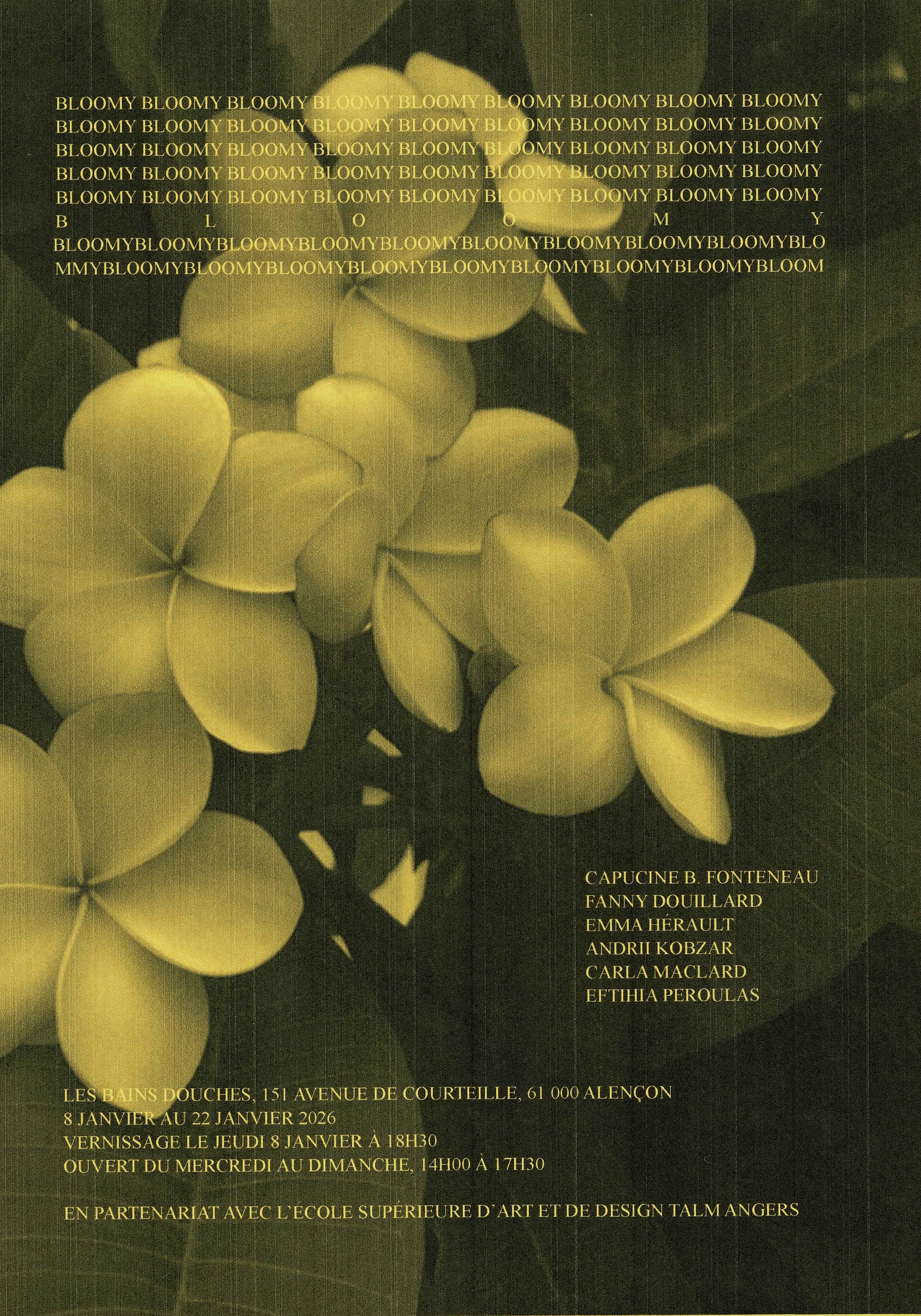
Bloomy
Capucine B Fonteneau, Fanny Douillard, Emma Hérault, Andrii Kozbar, Carla Maclard, Eftihia Peroulas
There is something exciting about imagining a group exhibition without any predefined strategy—something spontaneous, driven by the desire to show and share the work of six young artists we have come to know.
For about a year now, Géraldine, Pauline, Thomas, and I¹ have been exchanging ideas and weaving an organic, sensitive bond around a wide range of questions, within the framework of workshops with students from the École supérieure d’art et design TALM Angers: relationships to art, creation, school, necessity, money, social class, norms, utopias, relationships, gender, institutions, and possibilities. Free conversations, made up of shared desires and ideas that may or may not take shape.
What is an exhibition? What is a work of art? What is an artist? If we start from the premise that we do not know—and this is the choice we made together—then not knowing may become the place where everything becomes possible. It is certainly there that art school students and an art center can meet, question themselves, and evolve together.
The exhibition entitled Bloomy (like a generic brand or a hyaluronic acid cream) does not retreat into a theme, but rather explores everyday life and the experiences of people around the age of twenty-five who—perhaps like artists of yesterday and tomorrow—oppose consumerist logics, imposed labor, social conformism, and mechanisms of alienation.
In 1978, Brion Gysin and William S. Burroughs published The Third Mind, a concept of a mind that emerges through interaction, belongs to no one, and can be understood as a third language, opposing the vocabulary determined by and for power.
It is this elasticity that we have experienced together and that, I hope, will be revealed here. Capucine B. Fonteneau, Fanny Douillard, Emma Hérault, Andrii Kobzar, Carla Maclard, and Eftihia Peroulas question peripheries, memories, utopias, and archives with remarkable acuity of mind and poetic creativity.
It was the creative power of these six artists that initially caught our attention.. What is the starting point of these works? Where do they begin? What will they become? Although trained in the same school, their approaches ultimately share very little in common. Yet one major element unites them: they are guided neither by a predefined aesthetic nor by a dominant way of thinking. It is their lives—their recent youth—that they express through a great freedom of mediums, leaving room for a kaleidoscopic transfiguration of the everyday—an everyday life on acid, both luminous and inevitably anxiety-inducing, made up of poems written on receipts or medication leaflets; a paper cinema, without film or ending, a kind of new Nouvelle Vague; a dark painting of youth in a state of Eastern Europe; a theoretical investigation into sapphic narratives; stories of absence and disappearance; or reimagined landscapes revolving around heritage and the birth of death.
Rather than cataloguing, detailing, or defining each work and each artist, what we wish to offer here is a space for experience and dialogue with their practices—a moment to perceive what drives and connects them, without trying to fix or explain everything. This exhibition does not conclude: it opens situations.
¹ Workshops organized at Les Bains-Douches with Pauline Furon and Sophie Vinet, from September to April 2025, as part of the program Sur le chemin des glaces, led by instructors Thomas Bauer and Géraldine Gourbe.